

Most people think assessments exist to assign grades. That belief is understandable, but it only captures a fraction of what educational assessments actually do. The role of educational assessments explained properly reveals a far richer picture: these tools guide teachers in real time, signal where students need support, inform how schools allocate resources, and help governments measure whether education systems are working. Assessments serve teachers, families, and policymakers by supporting target setting and reporting at multiple levels. This article breaks down what that means in practice, so you can stop seeing assessments as judgment and start seeing them as information.
Table of Contents
- Key Takeaways
- The role of educational assessments explained: types and purposes
- How assessments benefit students, teachers, and parents
- Formative vs. summative: understanding the difference
- How assessment data shapes school and system decisions
- Practical strategies for using assessment results well
- My take on assessments as tools, not verdicts
- How Thrive-beyond puts assessment into practice
- FAQ
Key Takeaways
| Point | Details |
|---|---|
| Assessments do more than grade | They guide instruction, support student growth, and inform system-wide decisions beyond report cards. |
| Formative vs. summative distinction | Formative checks happen during learning; summative assessments measure what students achieved at the end. |
| Data quality determines usefulness | Reliable, interpretable results are what make assessment data worth acting on. |
| Parents can use assessment reports | Reading beyond the score reveals strengths, gaps, and next steps for supporting your child at home. |
| Growth matters more than snapshots | Tracking progress over time tells a more accurate story than any single test result. |
The role of educational assessments explained: types and purposes
The word "assessment" covers a wide range of tools, and mixing them up leads to confusion. There are four main categories educators work with, and each one serves a different purpose.
Formative assessments are the low-stakes, ongoing checks that happen during instruction. Think exit tickets at the end of a lesson, quick whiteboard responses, or a teacher asking one targeted question to the whole class. Formative assessment surfaces student understanding without assigning grades, giving teachers immediate information to adjust what they teach next. The goal is not to rank students. It is to catch misconceptions before they become habits.
Summative assessments measure what a student has learned after a defined period. Final exams, end-of-unit tests, and research papers all fall into this category. These results tell you where a student landed, but they do not tell you how to change tomorrow's lesson.
Interim assessments sit between the two. They are given periodically throughout the year, often at the end of a quarter, to check whether students are on track before the final summative measure arrives. They give teachers a mid-course correction opportunity without waiting until it is too late.
System-level assessments are large-scale tools designed to measure how an entire education system is performing. They are not meant to evaluate individual students or schools. Instead, they identify broad trends and improvement areas across regions or countries.
Here is a quick comparison to make these distinctions concrete:
| Assessment type | Timing | Primary purpose | Common examples |
|---|---|---|---|
| Formative | During instruction | Adjust teaching in real time | Exit tickets, whiteboard checks, quick quizzes |
| Summative | End of unit or course | Measure final achievement | Final exams, research papers, standardized tests |
| Interim | Periodically mid-year | Monitor progress and guide planning | Quarterly benchmark tests |
| System-level | Large-scale, periodic | Monitor education system health | National sample assessments |
Each type answers a different question. Formative asks, "What does this student need right now?" Summative asks, "What did this student achieve?" System-level asks, "Is our education system working?"
How assessments benefit students, teachers, and parents
The practical payoff of good assessment practice is significant, and the research backs this up clearly. Formative assessment strategies produced gains of +25.3% in academic achievement and +31.7% in student engagement, with the strongest results tied to immediate, content-specific feedback. Those are not small numbers. They reflect what happens when teachers use assessment data to respond quickly rather than waiting for a final grade.
For teachers, the benefit is precision. Instead of guessing which students are confused, formative data shows exactly who needs reteaching and who is ready to move on. Teachers can group students by need, target small-group instruction, and stop spending time on content students already understand. Actionable assessment data drives better instructional decisions than intuition alone.
For students, regular feedback creates a clearer picture of their own learning. When a student sees that they consistently struggle with a specific concept, they can ask for help on that exact thing rather than feeling generally lost. Assessment stops feeling like a verdict and starts feeling like a map.

For parents, assessment reports provide a window into what is actually happening in the classroom. A score alone tells you little. But a report that shows a child's growth over time, identifies specific skill gaps, and explains what support looks like gives you something to work with at home and in conversations with teachers.
Pro Tip: When reviewing your child's assessment report, look for growth data alongside the score. A child who moved from the 40th to the 55th percentile over one school year is making real progress, even if the score does not look impressive on its own.
Here is what good assessment data does for each stakeholder:
- Teachers: Identifies which students need reteaching and which are ready to advance
- Students: Provides specific feedback on strengths and areas to improve
- Parents: Offers concrete information to support learning conversations at home
- School leaders: Guides staffing, resource allocation, and professional development priorities
Formative vs. summative: understanding the difference
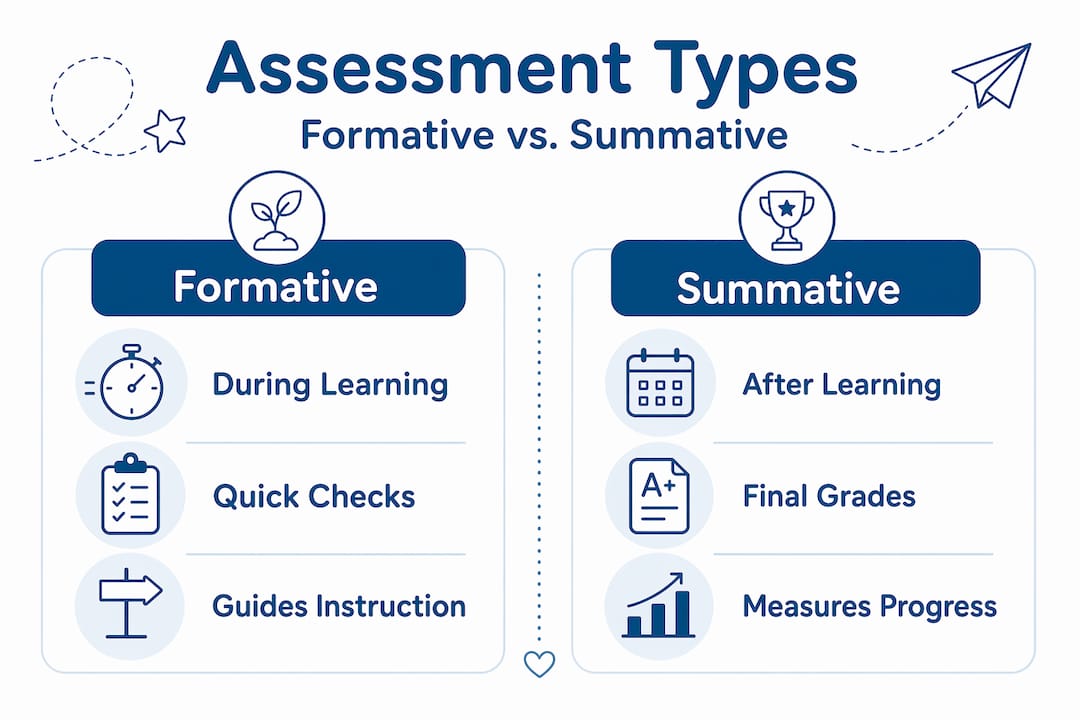
The confusion between formative and summative assessments is one of the most common misunderstandings in education. Getting this distinction right changes how you interpret results and how you respond to them.
Formative assessments monitor ongoing learning and provide continuous feedback, while summative assessments measure final achievement against a benchmark. The timing and intent are completely different, and that matters.
Here is a numbered breakdown of how to think about each type:
- Formative assessment happens during the learning process. A teacher gives a short quiz on Tuesday not to record a grade but to see whether students understood Monday's lesson before moving on.
- Summative assessment happens after the learning process. A final exam at the end of the semester captures what a student retained and understood across the whole course.
- Feedback timing drives the impact. Formative feedback works because it arrives while there is still time to change course. Summative feedback arrives after the course is over, so its value lies in informing the next learning cycle, not the current one.
- Both types serve a purpose together. Relying only on summative assessments leaves teachers flying blind during instruction. Relying only on formative checks means you never have a clear picture of overall achievement.
| Feature | Formative | Summative |
|---|---|---|
| When it happens | During instruction | After instruction |
| Stakes | Low | Higher |
| Feedback speed | Immediate | Delayed |
| Primary use | Adjust teaching | Evaluate achievement |
The key insight is that these two types are not in competition. They work best as partners in a well-designed educational approach.
How assessment data shapes school and system decisions
Individual student results are only part of the story. Assessment data also drives decisions at the school and system level, and parents deserve to understand that dimension.
System-level sample assessments measure education system effectiveness without evaluating individual students or schools. These large-scale tools identify performance trends across entire regions and flag where systemic improvement is needed. When a national assessment reveals that students in a particular region consistently struggle with reading comprehension, that finding can redirect funding, training, and curriculum resources to where they are most needed.
Here is how assessment data operates beyond the individual classroom:
- Schools use aggregated results to identify which grade levels or subject areas need additional support
- Principals and curriculum coordinators use data to plan professional development for teachers
- District and government leaders use system-level results to measure whether education policies are working
- Resource allocation decisions, including staffing ratios and intervention programs, are informed by patterns in assessment data
Tools like MAP Growth adaptive testing illustrate how large-scale assessments can provide interpretable, reliable scores that inform decisions at multiple levels simultaneously. The design quality of the assessment matters enormously. Unclear or unreliable data can actually hinder improvement rather than support it.
Parents sometimes feel frustrated when they learn their child's test results contribute to system monitoring rather than directly benefiting their child. That reaction is understandable. But system-level improvement does benefit every child, just on a longer timeline.
Practical strategies for using assessment results well
Knowing assessments exist is one thing. Knowing what to do with the results is where real value gets unlocked.
For parents, start by asking teachers to explain what a report actually measures. Most assessment reports include more than a score. They show which skills were tested, how your child performed on each one, and how that compares to expected growth. Understanding growth over time gives you a far more accurate picture than a single data point.
Encourage your child to reflect on their own results. Ask them what they found hard, what felt easier than expected, and what they want to work on. This builds metacognitive habits that serve students far beyond any single test. Students who learn to interpret their own feedback become more self-directed learners over time.
For educators, the most powerful move is acting on formative data quickly. Immediate, content-linked feedback drives the strongest learning gains. Waiting a week to address a misconception identified on Monday's exit ticket loses the window when correction is most effective.
Pro Tip: Avoid the trap of focusing only on grades when reviewing assessments with your child. Ask instead: "What did you learn from this?" That shift in framing turns every assessment into a growth conversation rather than a judgment.
One of the most common pitfalls for both parents and educators is treating a single assessment result as a fixed measure of a child's ability. It is not. It is a snapshot of one moment. Growth, patterns across multiple assessments, and the quality of the assessment itself all matter more than any single score.
My take on assessments as tools, not verdicts
I have worked alongside educators and families long enough to see the same pattern repeat itself. A child gets a score back, a parent feels anxious, and the conversation immediately shifts to what went wrong. The assessment becomes a verdict rather than a starting point.
What I have learned is that the most effective educators treat every assessment result as a question, not an answer. When a student scores poorly on a formative check, the first response is not "this student is struggling." It is "what did this student misunderstand, and how do I address it before the next lesson?" That reframe changes everything.
Parents often do not realize that many assessments are not designed to evaluate their child at all. System-level assessments, in particular, are about measuring how well the education system is serving students collectively. When parents understand that distinction, they stop feeling defensive about scores and start seeing assessments as part of a larger effort to improve education for everyone.
The hardest truth I have encountered is that assessment data is only as useful as the support structures around it. A teacher with 35 students, no planning time, and unclear data reports cannot act on formative feedback the way research shows is possible. High-quality assessment requires not just good tools but the time and training to use them well. That is a systems problem, not a teacher problem.
When assessments are used the way they are designed to be used, they are among the most powerful tools we have for making sure every child gets what they actually need.
— shawndrika
How Thrive-beyond puts assessment into practice

At Thrive Beyond Academy, assessment is not an afterthought. It is woven into how every student is taught and supported from day one. Because class sizes are small and instruction is personalized, teachers can act on formative feedback in real time rather than waiting for a quarterly report to reveal a gap that has been growing for months.
Thrive-beyond's approach recognizes that every child learns differently, and that means assessment results need to inform instruction at the individual level, not just the classroom average. If you are a parent wondering whether your child's current school is using assessment data to actually support growth, explore what makes Thrive-beyond different and see how a personalized learning environment changes what assessment can accomplish. You can also review all available programs to find the right fit for your child's needs and learning style.
FAQ
What is the main purpose of educational assessments?
Educational assessments serve multiple purposes: they help teachers adjust instruction, give students feedback on their learning, inform parents about progress, and help education systems identify where improvement is needed.
What is the difference between formative and summative assessments?
Formative assessments happen during instruction and provide ongoing feedback to guide teaching, while summative assessments measure final achievement at the end of a unit or course.
How do assessment results help teachers improve instruction?
Teachers use formative assessment data to identify misconceptions quickly and adjust upcoming lessons, group students by need, and target reteaching before gaps widen.
Are standardized tests designed to evaluate individual students?
Not always. System-level standardized assessments are designed to measure how well an education system is performing overall, not to rank or grade individual students.
How can parents make better use of assessment reports?
Look beyond the score and focus on growth trends, specific skill breakdowns, and teacher commentary. Ask your child's teacher to walk you through what the report actually measures and what support looks like at home.