
Every classroom holds students who are ready to sprint, students who need a steadier pace, and students somewhere in between. Uniform instruction serves none of them well. When you implement differentiated instruction in your classroom, you give every learner a genuine shot at the same rigorous goals through flexible pathways. Known formally as differentiated instruction (DI), this approach was shaped largely by education researcher Carol Ann Tomlinson and has since become one of the most evidence-backed models in student-centered learning. This guide walks you through the foundations, the planning, the execution, and the system-level supports that make DI stick.
Table of Contents
- Key takeaways
- How to implement differentiated instruction classroom-wide
- Preparing your classroom for differentiation
- Executing differentiation effectively in the classroom
- Sustaining and scaling differentiation school-wide
- My honest take on what actually works
- How Thrive-beyond supports differentiated learning
- FAQ
Key takeaways
| Point | Details |
|---|---|
| Start with clear learning targets | Measurable objectives anchor all differentiation decisions and keep groupings aligned to the same goals. |
| Use data, not guesswork | Pre-assessments and exit tickets drive fluid grouping and reduce prep time compared to rewriting entire lessons. |
| Differentiate four levers | Adjust content, process, product, or environment. You rarely need to change all four at once. |
| Plan for all learners | Advanced students need challenge and choice built in, not just extra worksheets after finishing early. |
| Sustain with system support | Coaching, PLCs, and administrator engagement are what separate one-year experiments from lasting school culture. |
How to implement differentiated instruction classroom-wide
Before you rearrange a single desk or print a single tiered worksheet, you need a clear picture of what differentiated instruction actually is and is not. Teachers frequently describe DI as creating multiple separate lesson plans for every student. That framing burns people out before they start.
Tomlinson's framework defines differentiation as proactive, flexible instruction that adjusts along four levers: content, process, product, and learning environment. The learning target stays the same for everyone. What changes is how students access the material, how they work through it, and how they demonstrate understanding.
The three student variables that drive those adjustments are:
- Readiness: Where a student currently is relative to the learning goal, based on evidence, not assumption.
- Interests: What topics or contexts motivate a student to engage with the content.
- Learning profile: How a student processes information most effectively, including sensory preferences and prior knowledge.
The goal is equitable access, not equal treatment. Giving every student the same text at the same reading level is equal. Giving each student a text at the right complexity level to reach the same comprehension standard is equitable. That distinction is the philosophical core of how differentiated instruction works.
Preparing your classroom for differentiation
Preparation is where most differentiation efforts succeed or fail. Teachers who skip this phase end up improvising, and improvised differentiation rarely holds up past October.

Step 1: Write measurable learning targets. Every differentiation decision flows from a clear objective. "Students will analyze cause and effect in a historical event using textual evidence" gives you something to differentiate around. "Students will learn about history" gives you nothing.
Step 2: Run a pre-assessment. A short, focused pre-assessment before a new unit tells you exactly where each student stands. Formative data collection takes less prep time than redesigning lessons and gives you the evidence you need to form flexible groups.
Step 3: Plan your tiers. Align your groups with MTSS tiers. Tier 1 is core instruction for all students. Tier 2 adds targeted support for students who need reinforcement. Tier 3 provides individualized, documented intervention. Planning these tiers before the lesson prevents you from improvising supports during instruction, which disrupts the flow for everyone.
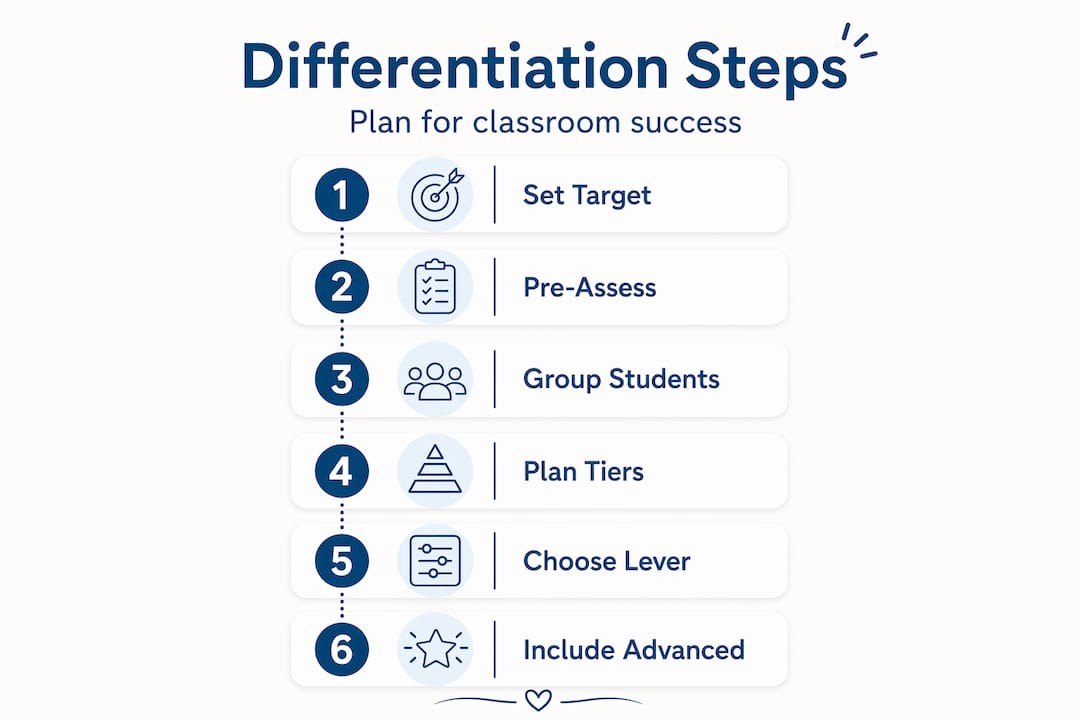
Step 4: Choose your differentiation lever. You do not need to modify all four levers at once. Pick the one that addresses the identified gap. A comparison of common approaches:
| Lever | What you adjust | Example |
|---|---|---|
| Content | What students learn from | Audio recordings vs. grade-level text vs. advanced primary sources |
| Process | How students work through ideas | Graphic organizers vs. Socratic discussion vs. independent inquiry |
| Product | How students show understanding | Illustrated timeline vs. written analysis vs. multimedia presentation |
| Environment | Where and how students work | Quiet corner vs. collaborative table vs. movement-based station |
Step 5: Include advanced learners deliberately. Advanced learner differentiation works best when challenge and choice are embedded in core instruction, not tacked on as extra work. Build multiple pathways into the lesson design from the start.
Pro Tip: Create a simple one-page planning template with columns for learning target, pre-assessment data, grouping, and the lever you are adjusting. Consistency in planning reduces cognitive load over time.
Executing differentiation effectively in the classroom
A well-structured lesson is the engine of effective differentiated teaching strategies. Here is a practical sequence that works across grade levels.
-
Launch with a clear mini-lesson. Keep it tight, roughly 10 to 15 minutes. Establish the learning goal, activate prior knowledge, and set routines. Clear lesson launches reduce ambiguity and free up cognitive space for differentiated work time.
-
Move into flexible group work. This is the heart of the lesson, approximately 30 to 35 percent of total class time. Groups work on tasks calibrated to their readiness or interest. You circulate, observe, and ask probing questions rather than re-teaching to the whole class.
-
Build in a brain break. A two to three minute transition between group work and independent practice resets focus. It also gives you a natural checkpoint to redirect groups or adjust tasks based on what you observed.
-
Independent practice and continued support. Students consolidate learning individually while you pull small groups for Tier 2 or Tier 3 support. Preplanned Tier 3 supports should be individualized and documented, not improvised during this phase.
-
Close with reflection and a formative check. Exit tickets, quick quizzes, or a written response give you the data to regroup students for the next lesson. This is how customized learning in classrooms stays responsive rather than static.
Here are common pitfalls to avoid during execution:
- Treating groups as permanent. Fluid groupings based on current data are a defining feature of DI. Rigid groups become tracking.
- Differentiating only for struggling learners. Differentiation misapplied to only one end of the readiness spectrum misses the point and leaves advanced learners disengaged.
- Overcomplicating the lesson. Keeping learning targets consistent while modifying tasks along one lever is more sustainable than creating entirely separate lesson versions.
Pro Tip: Use a simple color-coded clipboard system to track which students you have checked in with during group work. It takes 30 seconds to set up and prevents the common problem of spending all your time with one group.
Sustaining and scaling differentiation school-wide
A teacher can implement differentiated instruction in their classroom with skill and consistency. But without system-level support, that practice tends to erode when the school year gets hard. Scaling DI requires deliberate infrastructure.
The advantages of differentiated instruction multiply when leadership is actively involved. Research from North Carolina identifies shared leadership and strong instructional coaching as non-negotiable for sustaining instructional reforms. A principal who observes differentiated lessons, asks about grouping data, and protects intervention time sends a clear message about priorities.
Key system supports that sustain differentiation over time include:
- Professional learning communities (PLCs): Collaborative data dives within PLCs help teachers analyze student performance, refine groupings, and share what is working. Schools using PLC data analysis sustain differentiated instruction more effectively than those relying on one-time training.
- Instructional coaching: Coaches who model lessons, co-plan, and provide non-evaluative feedback build teacher confidence faster than any workshop.
- Train-the-trainer professional development: Equipping teacher leaders to support their colleagues creates internal capacity that outlasts any outside consultant.
- Protected intervention time: Scheduling dedicated blocks for Tier 2 and Tier 3 support prevents differentiation from being squeezed out by competing demands.
- Universal Design for Learning (UDL) integration: UDL frames accessibility as the foundation of inclusive design, not a retrofit. Building multiple options for engagement, representation, and expression into lesson planning from the start reduces the need for individual accommodations later.
Pro Tip: Schedule a monthly 20-minute "data walk" where grade-level teams review student grouping data together. Short, regular cycles of collaborative reflection outperform quarterly data meetings every time.
The role of differentiated instruction at the school level is not just pedagogical. It is a commitment to the belief that every student's trajectory is worth monitoring and adjusting for.
My honest take on what actually works
I've watched teachers attempt differentiation with enormous enthusiasm and burn out within a semester. And I've seen others build quiet, sustainable systems that genuinely change outcomes for kids. The difference almost never comes down to talent. It comes down to planning discipline and honest data use.
What I've learned is that the biggest mistake educators make is trying to differentiate everything at once. Pick one unit. Pick one lever. Get the pre-assessment data, form the groups, run the lesson, collect the exit ticket. Do that cycle three or four times until it feels automatic. Then add complexity.
I've also seen how much administrator support matters in ways that aren't always obvious. It's not just about resources. When a principal asks a teacher, "How did your groups respond to that task today?" it signals that differentiation is a professional expectation, not an optional extra. That question changes culture.
The other thing I'd push back on is the assumption that differentiation is primarily about supporting struggling students. In my experience, the students who benefit most visibly and quickly from well-executed DI are often the advanced learners who have spent years being bored. When you build real challenge and choice into core instruction, their engagement shifts noticeably. That shift tends to lift the energy of the whole room.
Becoming a skilled differentiator is iterative. You will not get it right the first time. The goal is to get better data, make better grouping decisions, and adjust more confidently with each cycle.
— shawndrika
How Thrive-beyond supports differentiated learning

At Thrive Beyond Academy, differentiated instruction is not a strategy layered onto a traditional model. It is built into the foundation of how every program operates. Small-group learning, individualized instruction, and hands-on enrichment are standard practice, not special accommodations. Whether you are an educator looking to see these principles in action or an administrator exploring models that prioritize every learner, Thrive-beyond offers a concrete example of what student-centered education looks like at scale. Explore our programs to see how each pathway is designed to meet students where they are and move them forward with intention and care.
FAQ
What does it mean to differentiate instruction?
Differentiated instruction means adjusting content, process, product, or learning environment to meet students at their current readiness level, interest, or learning profile while keeping the same learning target for all.
How do I group students for differentiated instruction?
Use pre-assessment data to form flexible, temporary groups based on readiness. Groups should shift regularly as students demonstrate progress, not remain fixed throughout a unit or year.
What are examples of differentiated instruction techniques?
Common examples include tiered texts at different reading levels, graphic organizers for students who need scaffolding, open-ended projects for advanced learners, and choice boards that let students select how they demonstrate understanding.
How does differentiation differ from individualized instruction?
Differentiation adjusts instruction for groups of students based on shared readiness or interest patterns. Individualized instruction tailors learning to a single student's specific plan, such as an IEP. Both are forms of personalized instruction, but differentiation is more scalable for classroom use.
How can administrators support differentiated instruction?
Administrators sustain differentiation by providing instructional coaching, protecting intervention time in the schedule, participating in learning walks, and making differentiation a visible part of professional expectations and evaluation conversations.